
Paid search can put your financial advice firm in front of prospective clients at the moment they are actively looking for help. That speed can be valuable, but paying for visibility does not guarantee that you are paying for the right attention.
Every click has a cost. If the targeting is too broad, the proposition is unclear or the landing page fails to continue the message, advertising spend can disappear without creating many worthwhile conversations.
Successful PPC for financial services therefore needs more than a well-managed Google Ads account. The search, advert, landing page and follow-up process should work as one journey designed around the clients the firm genuinely wants to attract.
PPC can buy immediate visibility. The rest of your marketing still has to turn that visibility into confidence, conversations and clients.
Give PPC a commercial role
Paid search is attractive because it can create visibility far more quickly than waiting for a new organic page to establish itself. That can be useful when the firm has adviser capacity, launches a new proposition or wants to increase demand around a particular service.
The speed also makes it easy to begin spending before the business has decided what success should look like. A clear marketing plan should establish which part of the firm PPC needs to support, who it should attract and what a commercially useful outcome looks like.
Reach active searchers
Appear when somebody is already expressing a financial need connected to your expertise.
Create visibility sooner
Support available adviser capacity or a developing proposition while organic visibility grows.
Test real market response
Use search and enquiry data to learn which audiences and messages generate useful interest.
Do not judge the campaign solely by the number of forms generated. For an advice business, the real outcome sits further down the journey: was the prospect relevant, did a useful conversation happen and did the relationship progress?
Do not begin by asking what you can advertise. Begin by asking which part of the business you want to grow.
Target better-fit searchers
A campaign aimed at anybody searching for financial advice will behave very differently from one designed around business owners preparing for a sale or people approaching retirement. The more clearly the firm understands the audience, the easier it becomes to recognise the searches worth paying for.
A defined target market also makes exclusions easier. If the business does not serve a particular need, geography or type of client, paid media should not repeatedly spend money creating enquiries the advice team cannot help.
Who should you attract?
Define the clients, circumstances and relationships the campaign is intended to support.
Why are they searching?
Identify the decision or concern that makes professional advice relevant now.
What makes the lead useful?
Agree what a suitable enquiry looks like before the advertising platform starts optimising for volume.
The campaign still needs a reason for the searcher to choose this firm. A clear value proposition connects the need with something relevant about the firm’s expertise, experience or way of working.
Targeting finds the audience
Positioning gives that audience a reason to consider your firm rather than another adviser appearing on the same page.
Build campaigns around search intent
A keyword with more searches is not automatically more valuable. Someone looking for a basic pension definition is behaving differently from somebody searching for a retirement adviser, even though both searches involve the same broad subject.
Higher-intent searches often justify more attention because the person is closer to comparing firms or beginning a conversation. Broader educational searches can still be useful, but the business needs a clear reason for paying to reach somebody who may be months or years from advice.
Group related searches
Keep terms with similar intent together so the message can remain focused.
Review actual search terms
Check what people really typed rather than relying only on the keyword list you intended to target.
Exclude irrelevant demand
Use negative keywords to reduce spend on careers, qualifications, free services or unsuitable products.
Separate different propositions
Give materially different audiences their own message rather than forcing one campaign to serve everybody.
Keep branded searches visible separately too. Somebody searching directly for the firm already carries more awareness than a person looking for a generic service, and combining the two can make new-client acquisition performance appear stronger than it really is.
Your keyword list shows what you intended to target. Search-term data shows who you actually paid to reach.
Connect the advert and landing page
A search advert has a small job. It needs to acknowledge the search, communicate one relevant reason to consider the firm and set an accurate expectation of what the person will find after clicking.
Trying to include every service, award and selling point usually weakens the message. Strong financial services copywriting uses the limited space to make the connection between the person’s need and the firm’s proposition clear.
A good advert does not say everything. It says enough of the right thing for the right person to keep going.
The landing page then needs to continue the same conversation. Someone who searched specifically for retirement advice should not arrive on a generic homepage and be expected to find the relevant service themselves.
Confirm the relevance
Make it immediately clear that the page relates to the search and advert that brought the visitor there.
Develop the proposition
Explain how the firm can help and why its experience may be relevant to somebody in that position.
Offer one clear next step
Give interested prospects a straightforward route towards a conversation.
The page should still feel part of the wider website. The visual identity, tone and adviser presentation should reinforce the firm rather than making the campaign look like a separate business created purely to capture a lead.
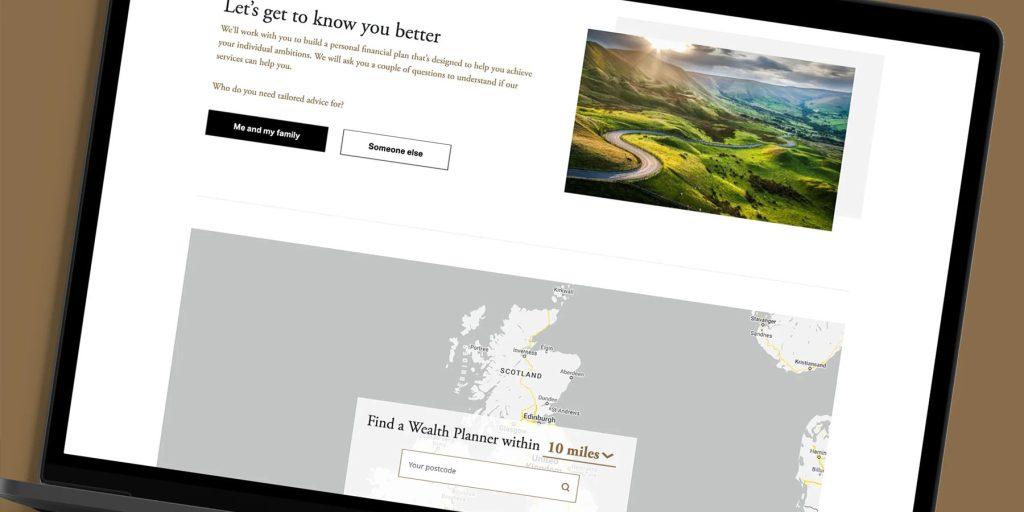
Build confidence and make contact easy
Financial advice is not an impulse purchase. Even somebody searching with strong intent may want to understand who provides the advice, whether the firm has relevant experience and what the first conversation involves before submitting a form.
The landing page should therefore provide enough evidence to support the proposition without becoming overwhelmed by badges, awards and generic claims. Relevant advisers, genuine client experiences and carefully chosen proof are usually more useful than trying to display every trust signal the business possesses.
The click may be paid for
Trust still has to be earned through the experience the prospective client encounters afterwards.
Forms need a similar balance. Too many fields can make initial contact feel like an application, while too little information may create large amounts of adviser follow-up for obviously unsuitable enquiries.
Ask for enough context to understand why the person wants to speak, then explain what happens after submission. People are more comfortable beginning a process when they understand the commitment involved.
A good landing page does not only ask the prospect to get in touch. It makes getting in touch feel straightforward.

Protect the handover after the enquiry
Marketing does not stop when the form reaches the inbox. From the prospective client’s perspective, the acknowledgement and first response are simply the next stages of the same journey.
The business should know who owns new enquiries, how quickly they are acknowledged and how information from the campaign reaches the adviser. A polished landing page followed by several days of silence can undo much of the confidence the advertising created.
Acknowledge
Confirm that the enquiry arrived and set a realistic expectation for the response.
Route
Use campaign and form information to send the prospect to the appropriate adviser or team.
Respond
Move to genuine human contact promptly once somebody has requested a conversation.
Feed back
Return suitability and progression information to marketing so the campaign can improve.
Paid financial services communications also need to operate within the firm’s relevant approval and compliance processes. Advert copy, landing pages and later variations are much easier to manage when balanced messaging, ownership and version control are considered before launch rather than added afterwards.
The form submission is not the finish line
Generating an enquiry is a marketing outcome. Turning that interest into a valuable relationship depends on the process that follows.
Measure client quality, not just leads
Clicks, conversion rates and cost per enquiry are useful indicators, but they cannot tell the business whether those enquiries are worth having. A cheap lead can become expensive very quickly if advisers spend significant time speaking to people the firm is not equipped to serve.
Reporting should therefore connect PPC to the wider client acquisition process. Marketing needs to know what happened after the form, while advisers need an easy way to return that information.
What did PPC generate?
Track enquiries and the cost associated with producing them.
Were they suitable?
Understand whether the people broadly matched the audience and advice need intended.
What happened next?
Follow suitable prospects into conversations, opportunities and eventual client relationships.
A campaign producing 15 enquiries can be considerably stronger than one generating 50 if more of those 15 become useful adviser conversations. Optimisation should therefore move towards the clients the firm wants, not simply the conversion events the advertising platform can count most easily.
The busiest campaign is not automatically the best campaign.
Use paid search as part of a wider strategy
PPC and SEO do not need to compete. Paid search can create faster visibility and reveal useful information about demand, while organic search can gradually build an asset around commercially important questions without paying for every future visit.
A strong content library also gives interested visitors somewhere to continue when they are relevant but not yet ready to speak. This means the landing page does not need to answer every possible question itself.
Scale only when the full journey is working. Before increasing spend significantly, the firm should have confidence in the search terms, proposition, landing page, enquiry quality, follow-up and adviser capacity. Greater traffic does not solve weaknesses in any of those areas.
Prove the journey before increasing the traffic.
At Goldmine Media, we help financial advice and wealth management firms connect paid campaigns with the strategy, copy, landing pages and creative needed around them. A specialist financial services marketing partner can manage those disciplines as one client journey rather than several disconnected marketing tasks.
The aim is not simply to buy more clicks or generate a larger lead total. It is to make paid attention more relevant, more convincing and more commercially useful to the firm.
Paying for attention is straightforward. Building a journey that makes the attention valuable is where the real work begins.
Ready to collaborate?
If your firm needs paid campaigns that connect audience targeting, landing pages and follow-up around better-fit clients, we’d love to hear what you’re working on.

